
Myth and Memory
By Eleanor Heartney in Andre Zarre Gallery, 1997
You can download a pdf version of this article here:
In the past, Despo Magoni has explored the power plays that define the ever shifting balance of power in the gender wars. A series of works based on the game of chess, for instance, liberated the Queen from her secondary status as protector of the King. Free to pursue her own interests, she bounded freely across the game board. In other works, Magoni has focused on the conflicts that prick and tear the female psyche. Expressionistically painted figures and faces give visual form to the blocked desires, sense of entrapment, and interrupted connections that mark the life of 20th century women.
With the set of collages that compose The Book of the Dead Dad, she moves from an archetypal battle with the Oedipal father to a poignant recollection of her relationship with her own father. In these works, the classic representative of patriarchal society—so formidable and oppressive when contemplated in the abstract—is brought back to human scale.
The individual collages here are based on an artist's book which Magoni created from family photographs and letters written to her by her father over a 23 year period. Greek born Magoni had come to the United States in 1968, while her father remained in Greece. After his death in 1991, she felt a need to create something from their long correspondence.
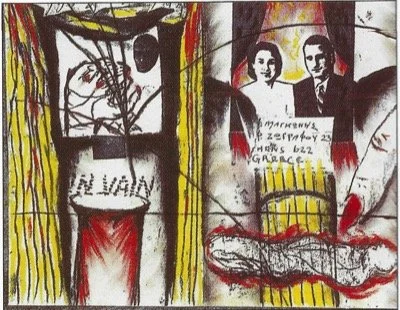
Book of the Dead Dad #10, 1995, 9 x 11 1/4 inches, M/M on rice paper
The Book of the Dead Dad is composed of 79 pages, one for each year of her father's life. Each page combines expressionistic drawings, xeroxed fragments of the letters, carefully composed in his native Greek, scrawled inscriptions and xeroxed pieces of photographs of her father and his large, extended family.
At once a diary for one who can no longer speak for himself, and an effort at communication with a loved one across the chasm of death, The Book of the Dead Dad is notable for its loving particularity. It records moments of tender-ness, as in a page that incorporates a photograph of her father teaching her son to swim. Another acknowledges her father's mid-life crisis through the use of a photograph he sent home to the family during the one vacation he felt compelled to take alone. Magoni examines her father's sense of dislocation from his own distant family in Crete.
The brook as a whole follows the path of raw memory, before the mind has been called in to restore order. As a result, the images have the quality of fading dreams. The father's handsome face and powerful form, carefully composed for the camera, mingles with other figures. The faces of parents, children, wife and grandchildren float up from the past and just as quickly disappear. One feels Magoni's frustration that memory is such an unreliable guide to the past.
Meanwhile, overlays of drawings and inscribed text provide the work's emotional con-tent. Over the staged cheer of the photographs; scrawled, scribbled and graffiti-like images tell the hidden story of interpersonal conflict, doubt, despair and hope. One page is dominated by block letters that spell out the ominous phase "The Civil War." Another is inscribed with the message "And there was pain between the lines." A page that contains the date of her father's death is marked with the phrase "End of the confusion.”
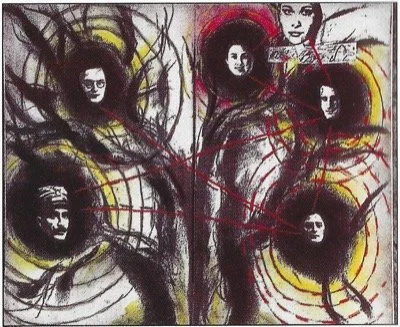
Book of the Dead Dad #27, 1995, 9 × 11 1/4 inches, M/M on rice paper
The marks and images tell a similar story. One page contains photographic faces surrounded by a scribbled coil of barbed wire. In another, the photograph of a small girl is repeated several times, each time imprisoned in a penciled box. Even the colors of the drawing—black, red and yellow—suggest a state of agitation and emotional distress.
In the end The Book of the Dead Dad attests to the enduring nature of the father-daughter bond. When they were separated by an ocean, photographs and letters tied Magoni to her father, across what must have seemed an immense geographical distance. Now faced with a more unfathomable chasm, memorabilia that once served as temporary substitutes for an absent loved one, have now become the only physical trace that remains behind.
The second series of works on exhibition here suggest how the artist has begun to work out the personal consequences of a parent's death. A child who has lost a father is often struck with a renewed realization of her own mortality. Magoni turns in The Thousand and One Nights to the mythic figure Scheherazade as her guide across the difficult terrain of mid-life.
In Magoni's hands, Scheherazade is no longer the young virgin who staves off the Sultan's revenge against her countrywomen by spinning a new tale every night. Now she is a mature woman whose promise of continued life is tempered by the knowledge that we must live day by day, or more accurately, night by night.
Magoni expresses this truth with a series of tempera on glassine drawings—10001 in all— of the night sky. In one set, representations of Scheherazade's face, depicted here as a mature woman with Magoni's own features, float in a band across the starry tapestry. In other sets, the night sky-dotted with pricks of light, flashes of nebulae, shooting stars and clouds illuminated by the moon—stands by itself.
Magoni's The Thousand and One Nights reminds us that the sky is a symbol of eternity. For millennia, humans have gazed upward at night and understand that the stars above have long preceded and will long outlast them. It is a thought that is both threatening and oddly reassuring. The night sky urges us to cast off human concerns for a moment, and to enjoy the knowledge that our own existence is but an imperceptible dot in the unbounded line of time.
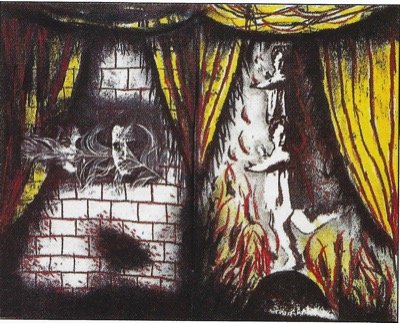
Book of the Dead Dad #45, 1995, 9 X 11 1/4 M/M on rice paper
Moving from one body of work to another, Magoni presents us with a disconcerting shift of scale. The diaristic quality of The Book of the Dead Dad immerses us in minutia of life, bringing back her father by reconstructing a series of fleeting moments and emotions. The Thousand and One Nights hurls us to the other end of experience. It brings us in touch with a vast, unthinking nature that is unaware of our existence. The shift is at once exhilarating and unsettling.
Blaise Pascal once confessed, "The eternal silence of these infinite spaces terrifies me." Magoni reminds us that there is freedom, as well as terror, in the unknown.