
On Pathos
By Barry Schwabsky, in Alternative Museum Exhibition Catalogue, 1986
You can download a pdf version of this article here:
Despo Magoni's recent paintings of single figures (or, occasionally, pairs of figures) are variations on a single theme—more accurately, on two themes that have become so intertwined as to be indivisible: pathos, suffering, and the relationship between men and women. It is only an apparent paradox that, in paintings that concern the relationship of men and women, they never appear together in the same picture. That isolation, that lack of connection, is very much to the point; and yet in the distortion and pathos to which Magoni's women and men are subject we can always read the influence of an unseen other.
Magoni's men are “magicians"--charlatans, performers, imposters. Whatever supernatural potency they claim to possess, one look at them shows that they can barely keep up appearances. Archaic emotions of fear and rage are always just below the surface. Magic claims to give a kind of effortless control over objects and other people. In fact it exists in order for fragile egos to maintain a modicum of control over themselves. Magic is a way of managing what Freud called "Das Unbehagen in der Kultur," man's discomfort in civilization.1 Magic enables the survival of the self at the cost of its self-mystification and alienation.2
Still, the magicians have "assistants." These are Magoni's women. They are the ones who undergo the real risks of the performance, who stand transfixed as the knives fly past them. They are the ones who give the magicians' theatrical act its tragic dimension, for it is our empathy with their suffering that evokes pity and fear.
In alluding to Aristotle's theory of tragedy I do not wish to give the impression that Magoni is a "literary" painter. She is not. Rather, she can usefully be compared to artists like Francis Bacon and Leon Golub, who connect with a painterly tradition of expressionist figuration and who use that tradition as a tool for a speculative interrogation of the figure's expressive capacity. For what we might call the classical figurative tradition the expressivity of the body was not subject to any radical doubt. This was assured because the human subject could be pictured in action (praxis) in the sense of a working out or realization of its freedom (even though this might end in failure). For Magoni, on the other hand, as for Bacon and Golub, the subject is, in its being, essentially determined, even over-determined; freedom of action exists somewhere on the margins of being, somewhere in the self-cancellations of conflicting determinations, perhaps. Where the body is essentially this crystallization of forces, where its primary experience is not that of praxis but of pathos, does it not become more reasonable to think of the body itself as an expression, rather than as something capable of expressing?
So the figure does not, perhaps, express; but through it, through its pathos, something may be expressed. To understand what this is we will examine the figure as physiognomy, but we must also, first, see how it relates to its ambient. The space the figure comes to inhabit in these paintings is extremely schematic, usually either a simple monotone ground, or one traversed by a vaguely indicated horizon, perhaps marked by grassy fronds or even a tree but almost always bereft of any detail that would suggest a particular setting or give an intelligible sense of place. This deliberate suppression of any referential grounding stands in sharp contrast to some of Magoni's earlier work, whose specificity was guaranteed by means as various as collaged newspaper photos or text, or the use of emblematic signs (e.g., in Premonitions, 1982, in which the artist's own face, attached to a nude body which has been generalized and distorted in a manner that clearly prefigures the more recent paintings, is juxtaposed to the Statue of Liberty, cuing a reading that includes both social models of gender and geographical displacement). This change in Magoni's work should not be taken to mean, however, that exterior (socially determined) circumstances have become irrelevant to the meaning of the figure, that the new paintings assert an individualism of the primal self. On the contrary, the figure has become the embodiment of all the forces that circulate through it, and which therefore no longer demand discreet representation. Pathos is no longer distinguishable from ethos; the figure has soaked up, like a sponge, the character of its surroundings, almost without remainder.
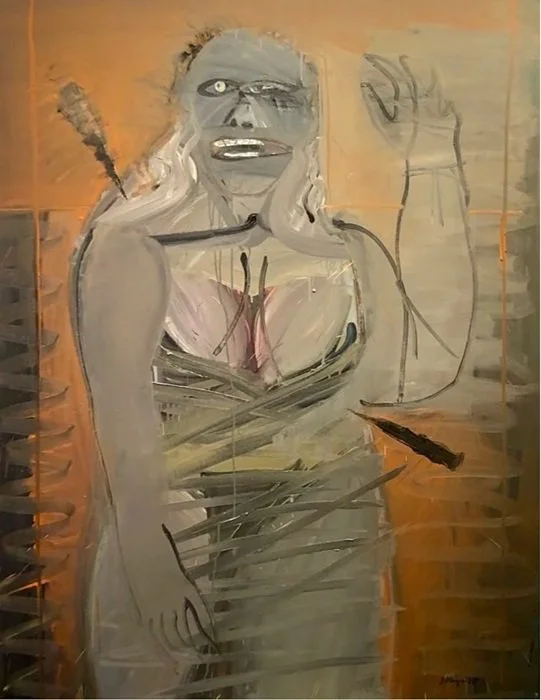
The Persistent Prima Donna, 1985, 52” x 40”, Oil on canvas
The function of the line that define's the body's boundary has become osmotic. Often the substance of the figure—its tone and texture, sometimes its color—is identical to that of the ground. Look, for instance, at The Persistent Prima Donna (one would assume that a prima donna, of all people, would be vividly set off from her surroundings) and notice how her raised arm and hand are distinguishable only by lines that have the irrisory character of a make-shift: lacking its own integrity, the figure is inscribed—scrawled, really—in an obstentatiously hasty, awkward manner. That this is most apparent in the representation of arms and hands, which metonymically represent action, praxis, constitutes an ironic reversal by which they are turned into signs of pathos.
Action as signified by the hand is subjected not only to this dissolution, but also to a kind of scission or splitting. Here The Deadly Performance may serve as an example. In this painting the assistant's right hand is, once again, a mere outline, dark grey against a light grey ground. And yet here that outline defines a difference: the phosphorescent yellow tint within the line, as though the flesh were somehow being assimilated to light—and yet at a certain point this tinge escapes the outline. By the time it reaches the fingers it has taken on a quite different position. Medical science tells us of the "phantom limbs" experienced by amputees. This is clearly something different, yet it is a phantom or ghost of a kind as well; after all, in one of Magoni's paintings her magician is doubled by an outline in just this yellow, and that painting is called The Ghost. In The Deadly Performance we can understand this phantom, this incipient double (doppelgänger) as the effect of a self-dissociation ("She was beside herself," we say in such cases) caused by fear.
A third version of the hand: Stage Fright. In the left hand, the outline, dissolving into the grey of the woman's chest, is drawn out, elongated, so that the fingers seem to be pulled like a taffy, their form rendered tenuous. And then the right hand becomes a blur of soft bristle - or quill-like lines, a hysterical fanning of the air: action reduced to unproductive motion.
In all of these cases the hand has begun to lose its identity. It has suffered a wound, not to its surface (although it has an outline, it has no surface, strictly speaking) but to its form. In general they are disproportionately large—and of what use could those fingers be? Often they look more like soft claws of some kind, malleable but without real articulation, unsuited for sensing and grasping. One might say that they are to fingers what a bellow of pain is to language. Their gestures are of warding off, but are only gestures.
More important as an organ of articulation than the hand is the face, so our account of Magoni's anatomy of pathos should continue there, and in particular with the paintings that focus on the head, the "portraits" of The Wounded Magician. In #1, the dominating feature is the mouth, a black splotch, an erasure of expression, after which we notice the eyes, which are in odd contrast to one another: one dark, the pupil a barely discernable hint of a circle; the other bright, the pupil focused to an intense point. If the eyes are windows of the soul, then this soul is divided against itself. But perhaps we should doubt whether even that unconscious expressive power is theirs. It may be that the eyes contradict each other, not because they express a complex psychic state, but because they fail to express one. Certainly the mouth here, emblematic of non-communication, is a sign of self-repression, a determination not to express pain and weakness (but it expresses these things despite itself, through the very effort to avoid expression).
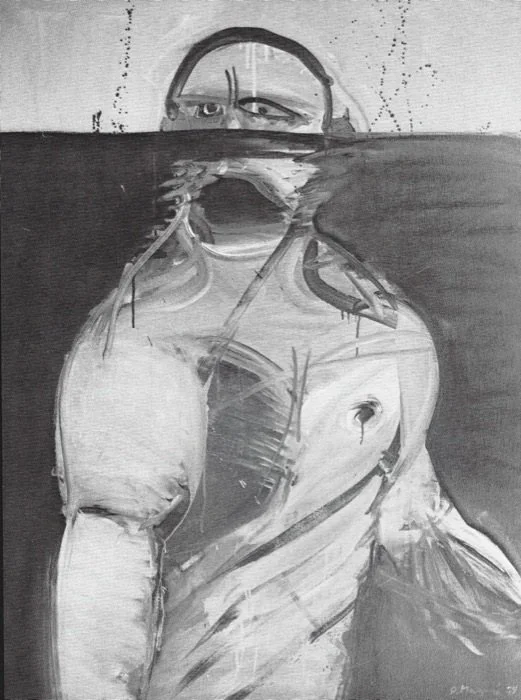
Poseidon's Phobia, 1984, 40" x 30", Oil on canvas
In The Wounded Magician #2 the mouth is open, the teeth flashing brightly. This grimace no longer completely holds back the signs of pain as the magician did in #1, and yet it is equally far from the open -mouthed scream of, say, Bacon's Popes. The lips are open but the teeth are still closed tight, a contradiction like that of the eyes in #1. Still the will remains to hold back expression, to maintain pathos in its pure form rather than allow it to pass over into the action of utterance. For an open mouth we must look to Poseidon's Phobia and The Deadly Performance. In the former the magician is shown, ironically, to be like god overwhelmed by his own element, the god of the sea terrified by water. Howling with fear and rage, he remains unheard—water does not carry sound. The assistant in The Deadly Performance, on the other hand, is not venting emotion; her mouth is open with the O of surprise. What is remarkable about each of these instances is how the mouth, however abstractly rendered, whatever the artist's indifference to realistic anatomy, has a very specific emotional charac-ter, a specific expressivity, and that this is derived, paradoxically, from the portrayed figure's refusal or inability to express its pain. "Pathos," as Northrop Frye once pointed out, "is increased by the inarticulateness of the victim... some failure of expression, real or simulated, seems to be peculiar to it. “3
If the expression of pathos is its active moment, a primitive form of praxis, and if even its repression is an unwilled or ironic expression, then pathos in its purest form will have its site where expression is not given and yet things are felt deeply, as though from within. We say of such primal feeling, "I felt it in my guts." So it is not surprising that Magoni's most agitated, but also some of her most fluid and vigorous painting-her most expressive painting, in fact—happens when she paints the bellies of her characters (but only of the women, the assistants, as though her empathy with the men, the magicians, extends only so far, not to this "visceral" level).
Here we see a difference in the way significance is produced within the painting. Our readings of the hand or of the face occupied, so to speak, an interpretive space opened up by the discrepancy between pathos and its expression or non-expression (which amounted to two forms of the same thing), a discrepancy made possible by an impurity within pathos, by which the germ of praxis was already lodged within it. But the passages of painting which concern us now, those describing their abdomens, their guts (and these passages do seem to be describing something internal rather than on the body's exterior), are ones in which pure pathos and pure expression coincide. And they coincide not in relation to one another, as two parts of the same structure, but as a kind of congruence at every point which allows each to be independent, because pathos and expression here are simply two different ways of understanding the same phenomenon.
Look at the slashing, looping brushstrokes which make up the belly of the assistant in Dead End. As violent as they are, their rhythmic, calligraphic quality is like a dance of freedom. These lines come together like a knot—and it is precisely because this image of the knot arises-here that we are able to suggest, at last, what truly distinguishes the human figure in these paintings from the forces surrounding them and which work through them. What distinguishes a knot is not the substance of which it is formed (and we have seen how Magoni's figures do not appear to be of a distinct substance from the field in which they occur but rather its structure, which is determined by the way force is pulled and turned around itself, maintaining itself through a network of pressures and interferences. So at the core of these figures there exists a kind of knot, a place where the forces pull themselves into a structure that maintains an identity, something irreducible, and blocking further interpretation.
Nietzsche saw the Apollonian culture of classical Greece as the overcoming of an archaic world of terror and suffering which, however, lived on at the very core of that culture. "With this mirroring of beauty the Hellenic will combated its artistically correlative talent for suffering and for the wisdom of suffering."4 Magoni's effort is to enact a stripping away of this Apollonian illusion (as embodied, perhaps, in her strictly academic art education in Greece). What remains after this stripping away is not a true archaic state but rather an atavistic one, not pre- but post-Apollonian. "These were beautiful creatures once, but then something happened…”5 What happened was that they entered into the sphere of Magoni's art, one that affirms beauty through its absence, action through suffering.
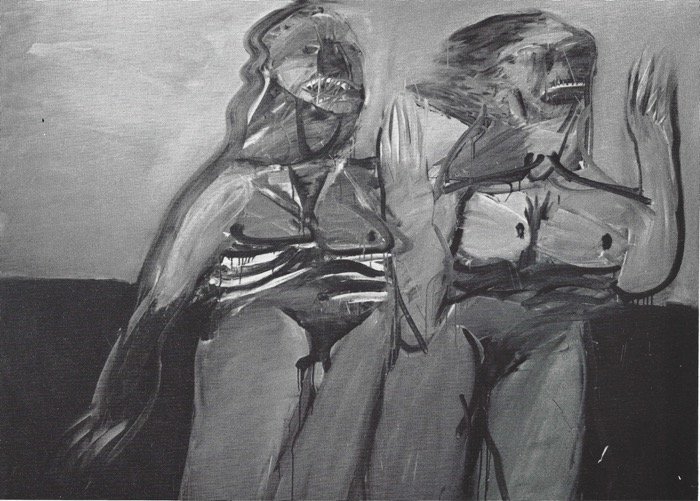
On A Cold And Starless Night, 1985, 52" x 72", Oil on canvas
In the most recent paintings in this series, however (On a Cold and Starless Night, The Night Journey, Midnight Grief) Magoni has begun to move on to a different stage, for here the women are not victims of suffering, but its survivors. At last they give themselves up to lamentation: the urge to repress utterance has come to an end. These paintings are, it seems to me, transitional ones. The subject of the paintings has begun to change, but the formal means have not kept pace. Since most artists develop their ideas on paper before they work out a way to apply them to the more elaborate demands of paint on canvas, I look to Magoni's recent drawings to see where her art may be headed. What I find there is that the figure is becoming more active, that it is going into motion, and that for this reason Magoni's formal inventiveness is increasing. Notable too is that the drawings make use of much lusher, higher-keyed color than the reserved, subtle tonalities of the paintings, which are dominated by a surprisingly suave range of nacreous greys.
But no one can predict the course of an artist's development. Magoni will make her future step by step, building on what has gone before as she has always done. What I feel more confident in saying, looking at the paintings she has already given us, is that, I do not believe that they have their roots in anger. Although they present an often bleak view of the relations between men and women, of the gulf between them, and especially of the wounding of women thereby, they are not essentially paintings of pro-test, because the pathos which is their subject, however histrionic, however shattering, is that of love.
Notes
1. "Man's discomfort in civilization" was Freud's own suggestion for an English translation of the title which Joan Riviere rendered into English as Civilization and its Discontents.
2. See Stolen Lightning: The Social History of Magic by Daniel Lawrence O'Keefe (New York:
Vintage, 1983).
3. Northrop Frye, Anatomy of Criticism (Princeton University Press, 1957), pp. 38-9.
4. Friedrich Nietzsche, The Birth of Tragedy, tr. by Walter Kaufmann (New York: Vintage, 1967), p. 44.
5. Despo Magoni, in conversation, December 1985.